



Where Should My Disaster Relief Donations Go?
Your disaster relief donations should go to the organizations most capable of making the most effective difference. According to the U.S. Federal Emergency Management Agency (FEMA), “Financial donations to recognized, vetted organizations is the fastest, most flexible and most effective method of donating.”[1] This is better than giving in-kind donations, such as bottled water or food, because these organizations know exactly what and how much is needed and they often have the means to purchase iteams at a discounted rate and, if possible, from a local business to help support the local economy as it recovers from disaster.

The other important factor in deciding where to donate is the organization’s proximity to the disaster or its ability to access that area. You wouldn’t want to donate to a locally-focused organization for a disaster that ocurred halfway across the world. It’s important to investigate whether a particular organization has a presence or network that allows them to serve those hardest hit by the disaster.
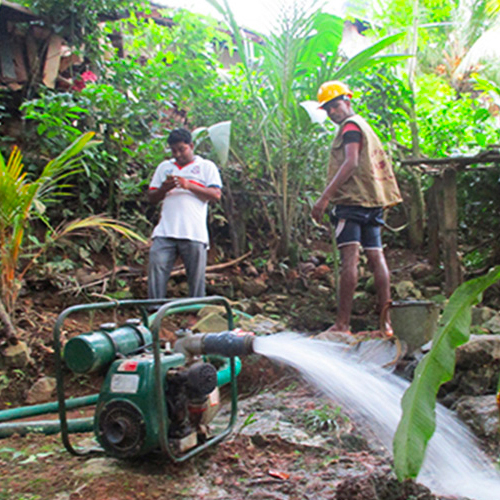
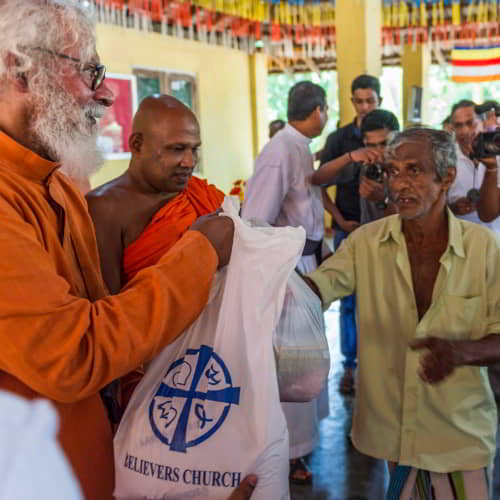
In 2017, for example, Sri Lanka was hit hard by flooding, devastating many areas. GFA World was already on the ground in the area and was able to provide critical assistance to those affected. GFA missionaries distributed dry rations and clothes, and when it was safe, GFA Compassion Services helped repair damaged well pumps so that clean water began flowing again.[2]
GFA already had many programs and churches in that area. This helped them to know immediately what was needed and where it was most needed. GFA Founder K.P. Yohannan (Metropolitan Yohan) also joined relief efforts, which went on for several months.
Yohannan said,
“In all these situations, there was one question the local people kept asking us: ‘Why are we doing this?’ Our answer always remains the same: It is because of the love of Christ.”
This is the other important aspect of deciding where you choose to give your donations for disaster relief. Many organizations deliver their care with kindness, for which so many are grateful, but many people in disaster-stricken areas have needs much deeper than their physical ones. GFA’s motivation will always be that Christ first loved us. GFA missionaries not only deliver what is physically needed but also what is spiritually needed through counsel and prayer.
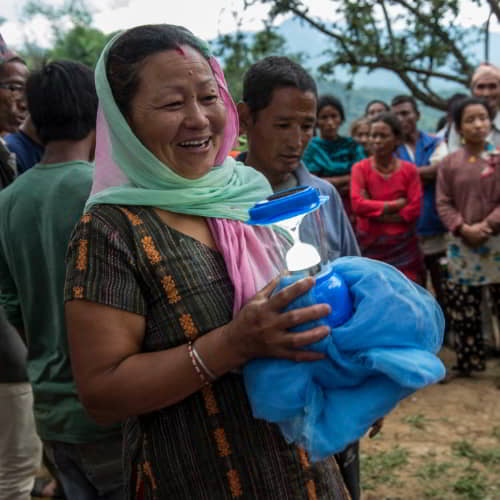
Give today to GFA’s disaster relief and Compassion Services teams. The GFA network is established in many countries with years of experience represented by the many GFA missionaries and churches. Donate with confidence and with the compassion of Jesus Christ.
You may not be able to physically be there to respond in times of disaster, but your giving can travel through the hands of fellow brothers and sisters in Christ who share your heart for the hurting.
Learn more on disaster relief organizations[1] “Volunteer and Donate.” Federal Emergency Disaster Agency. https://www.fema.gov/disaster/recover/volunteer-donate. Accessed November 26, 2022.
[2] “GFA Founder Visits Monastery to Provide Flood Relief Supplies.” GFA World. https://www.gfa.org/compassion-services/disaster-flood-relief/srilanka. Accessed November 26, 2022.